Smiley Ice Cream: A Playful Applique That Delivers
As someone who’s stitched hundreds of machine embroidery designs for clients, craft fairs, and Etsy shops—everything from delicate monograms to bold tote bag statements—I approached Smiley Ice Cream with quiet curiosity. Not hype, not skepticism—just the habit of asking: *Will this hold up in real life?* Not on screen, not in a catalog, but on a sun-bleached beach towel handed to a giggling three-year-old, or stitched onto a soft cotton onesie that’s washed weekly and loved fiercely.
First Impressions: Sweet, Simple, and Surprisingly Strategic
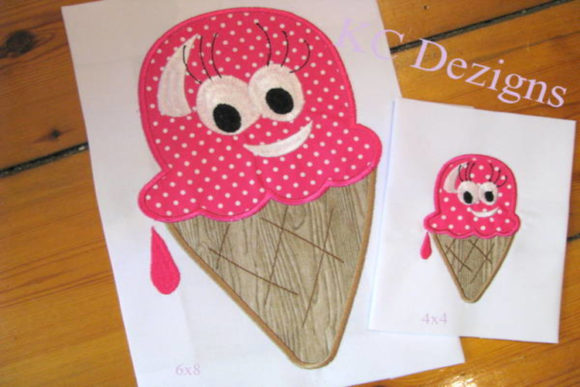
The Smiley Ice Cream applique lands exactly where it promises: cheerful, childlike, and uncluttered. It’s not trying to be photorealistic—it’s a distilled idea: a rounded cone, a generous scoop with a smiling face, clean curves, no tiny eyelashes or freckles begging for lost stitches. That restraint is its strength. As an embroidery file, it reads clearly at 3–4 inches wide—the sweet spot for baby embroidery, toddler sweatshirt fronts, or embroidered patch applications. The shape is friendly without being cloying; the smile feels genuine, not generic. It belongs in the Food category, yes—but more accurately, it lives in the space between snack-time joy and handmade warmth.
Where It Shines (and Where It Needs Care)
I tested Smiley Ice Cream across five real project types: a linen tea towel, a lightweight cotton tote, a ribbed knit baby onesie, a twill baseball cap, and a looped terry beach towel. Here’s what stood out:
- Tote bags & tea towels: Perfect. The design’s balanced weight and open negative space prevent puckering on medium-weight woven fabrics. Satin stitch edges stayed crisp; fill stitch areas held texture without stiffness.
- Baby items & onesies: Works beautifully—if you stabilize properly. I used tear-away + light cut-away under the knit. No skipped stitches, no distortion. Parents respond instantly to its gentle whimsy—it reads as “thoughtful,” not “trend-chasing.”
- Caps & curved surfaces: Proceed with caution. The round scoop and smile rely on smooth curvature. On a low-profile cap front, I resized down to 2.75" and rehooped carefully. It held, but the smile softened slightly. Not a dealbreaker—but not ideal for high-volume cap embroidery without minor digitizing tweaks.
- Dark or textured fabrics: Test thread colors early. The smile’s outline benefits from a contrasting satin stitch—navy on cream reads better than black on charcoal. On terry cloth, I added a layer of water-soluble stabilizer on top to keep the face details sharp.
- Frequent-wash items (blankets, bibs, kitchen towels): Solid construction. No loose running stitch elements. The applique base layer anchors well, and the satin border resists fraying through multiple cold washes.
What This Design Says About Your Brand—Without a Word
When you choose Smiley Ice Cream for your craft business or small shop product, you’re signaling something subtle but powerful: approachability, care, and attention to emotional resonance. It doesn’t scream “luxury” or “edgy”—it whispers “I made this for someone I love.” That matters. Customers browsing your Etsy shop don’t just buy an embroidered patch—they buy the feeling of nostalgia, sweetness, and summer ease. I’ve seen buyers tag friends in comments like *“This is SO [child’s name]!”*—proof that strong visual personality drives engagement.
For personalized gifts? It’s gold. Pair it with a simple name script below, and you’ve got a custom sweatshirt that feels curated, not mass-produced. For boutique branding? Use it as a subtle logo accent on packaging tags or apron pockets—not as a centerpiece, but as a wink of consistency.
Practical Designer Notes You’ll Actually Use
Before stitching Smiley Ice Cream into your next finished product, here’s what I do—and recommend you do too:
- Always test on scrap fabric first—especially if using stretchy, napped, or dark materials. Watch how the smile’s curve settles and whether the cone base shifts.
- Check stitch density visually. This isn’t a dense fill-stitch jungle—it’s breathable. That’s good for wearables, but confirm your machine handles the transitions smoothly.
- Confirm hoop size compatibility. The design fits standard 4x4 hoops comfortably, but if you’re scaling up for a pillow cover or blanket, verify stability at larger sizes.
- Inspect small details in black-and-white mockups. Does the smile read clearly against dark fabric? Does the cone taper cleanly? Don’t rely on color alone.
- Use appropriate stabilizer. Light cut-away for knits, tear-away for wovens, water-soluble overlay for terry or velvet. Skipping this step risks shadowing or distortion—especially around the curved scoop edge.
- Review licensing before selling. Since this is a machine applique embroidery design intended for use with an embroidery machine, confirm whether your purchase includes commercial rights for finished handmade products—or if redistribution of the digital embroidery file is restricted.
Final Thought: Joy With Integrity
Smiley Ice Cream isn’t flashy. It won’t win awards for technical complexity. But as an embroidery file, it delivers something rarer: reliability wrapped in charm. It performs consistently across fabric types, communicates clearly at scale, and enhances—not distracts from—the handmade product it lives on. Whether you’re stitching it for a holiday embroidery gift, prepping a batch of custom apparel for your small shop, or building design assets for client work, it earns its place not through novelty, but through quiet, stitch-perfect intention.
If your goal is to make people pause, smile, and say *“I need that in my life”—*not because it’s loud, but because it feels true—then Smiley Ice Cream is worth every hoop rotation.